PHOTOGRAPHIC DOCUMENTATION OF
ARCHITECTURAL MONUMENTS IN THE RUSSIAN NORTH: VOLOGDA
In the popular imagination,
virtually all Russia is north, cold, and imponderable. Yet within this vast territory,
there is a region north of Moscow that has a cultural coherence created by those who
settled in its forests and moved along its rivers and lakes. Even this limited area,
sometimes considered a stronghold of "pure" Russianness, contains a rich ethnic
and cultural variety derived from a complex interaction of history and geography.
Inhabited by Finnish tribes before the arrival of the first Slavic explorers and traders,
it served as a retreat and place of spiritual solace for the avatars of Muscovite
monasticism during the fourteenth and fifteenth centuries. At the same time the wealth of
its forests and lakes, and its position astride trading routes north to the White Sea and
west to the Baltic led to the creation of towns that themselves became repositories of
traditional Russian values in the arts and crafts.
The gateway to the north, and ultimately to the port of
Arkhangelsk, is the city of Yaroslavl, whose seventeenth-century architecture was the
subject of my article "Photographic Documentation of Seventeenth-Century
Architectural Monuments in Yaroslavl," Visual Resources (Vol. 11, No. 2). At
Yaroslavl the Volga River turns northwest and forms part of a major water-based shipping
route. But the road to the White Sea and the port of Arkhangelsk proceeds due north from
Yaroslavl to the city of Vologda, one of the historic and cultural centers of the Russian
north. Vologda's dim origins go back at least to the twelfth century, when the area was
explored and colonized by traders and settlers from Novgorod, located some 500 kilometers
to the west of Vologda and one of the most important economic centers of medieval Russia.
By the end of the fourteenth century, Moscow had its own
representatives in the town; and a century later, after a prolonged, complicated struggle,
Vologda and its surrounding territory were taken into the Moscow principality. By the
middle of the sixteenth century, Vologda had become the major trading and administrative
center in northern Russia. It served as the primary distribution point for rapidly
increasing trade with England, and subsequently Holland, by way of Arkhangelsk and the
Dvina River.
Vologda was built entirely of wood until the reign of Ivan
IV (the Terrible), who in 1565 included the town in his private domain (oprichnina) and
initiated construction of a masonry fortress, or kremlin, apparently to serve as his
northern residence (1). After 1571 this enterprise was
abandoned and the walls were eventually dismantled; but one important monument remains:
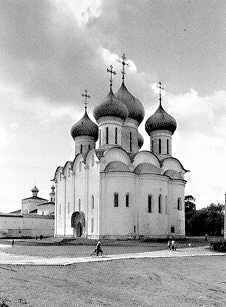
the Cathedral of Saint Sophia (Photo 1, 2, 3, 4, 5, 6,
7, 8, 9, 10).
Built in
1568-70, it is an excellent example of mid-sixteenth-century church architecture based on
Aristotle Fioravanti's Dormition Cathedral (1475-79) in the Moscow Kremlin. After the
Vologda eparchy expanded its territory in 1571, the Sophia Cathedral was intended to serve
as the seat of this bishopric. However, for various political reasons the cathedral was
not consecrated until 1588, after the death of Ivan the Terrible.
Fortunately, the Vologda Cathedral of St. Sophia has been
well preserved. Its whitewashed brick walls are outlined by pilaster strips leading to a
horizontal row of semicircular gables, or zakomary, which were restored to their original
configuration after the Second World War.
The segmentation of the exterior corresponds to the
interior bays and their vaulting, in the tradition of the inscribed-cross plan of
Russo-Byzantine church architecture. The onion domes, which provide a striking visual
culmination to the structure, evolved to their present form as the result of modifications
to the building during the seventeenth century. (Their original form would presumably have
been closer to the hemispherical shape still retained in the Dormition Cathedral of the
Moscow Kremlin.) The elaborate iron crosses above the cupolas were added in 1687.
Yet despite recent concern with historic preservation,
there have been dubious modifications to the area surrounding the cathedral.
A well-intended but ill-advised decision led in 1987 to the
placing of a large monument to the nineteenth-century poet Konstantin Batiushkov and his
horse on a small plaza between the approaches to the cathedral and the banks of the
Vologda River. As a result it is difficult to perceive or photograph the cathedral in its
context without the interference of this oversized sculptural group.
The interior of the Sophia Cathedral contains some of the
best surviving examples of late seventeenth-century Russian frescoes. In 1686 the
archbishop of Vologda, Gavriil, hired a group of approximately thirty artists from
Yaroslavl that included the most renowned fresco painters of the period, such as Dmitrii
Grigorev Plekhanov who had supervised the painting of the Dormition Cathedral at the
Trinity-Sergius Monastery near Moscow in 1684. In an era when western views of art as a
secular occupation were beginning to penetrate Russia, the artists painted on the walls a
list of their names and a large, elaborate description proclaiming the beginning and end
of their work, from July 1686 to the summer of 1688. (Such proclamations would rarely have
appeared in church art before the seventeenth century.)
The huge space of the cathedral interior was completely
painted and included major scenes devoted to the life of Christ and Mary, the parables of
Christ, and, on the west wall, a particularly vivid "Last Judgement," with
elegantly dressed foreigners descending to hell. Although these frescoes are relatively
well preserved, photographing them is subject to negotiation; and even then, only a brief
time is allowed for that purpose. The museum entrusted with maintaining the interior needs
additional revenue and is apparently concerned that such photographs not be used for
commercial purposes. At the same time, there are no complete, or even adequate, published
reproductions of the frescoes, which rank among the most significant examples of
seventeenth-century Russian fresco art. Given the current economic situation in Russia,
this dearth of photographic documentation seems likely to continue.
With the exception of the Sophia Cathedral, Vologda
throughout the sixteenth and early seventeenth centuries remained a collection of log
structures, more than once devastated by fires. In addition to these natural disasters,
the city was sacked in 1612, during the Time of Troubles. Nonetheless, Vologda's
strategically important position assured its continued existence on a scale that impressed
foreign merchants and emissaries, some of whom left drawings of its large expanse, covered
with church towers and log houses. With the recovery of the city in the 1620s and its
increasing wealth, masonry construction appeared more frequently as a partial antidote to
the ever present danger of fire.
The largest of such projects was a brick wall resembling a
fortress and built in 1671-75 to protect an ensemble of log buildings that comprised the
archbishop's residence near the Sophia Cathedral. Within the ensemble itself, the first
building to be rebuilt in brick (1659) served as an office and treasury. Its broad
interior spaces now house the collection of the Vologda Regional Museum, which is
distinguished by its collection of icons and folk art. Only a small part of this
collection has been adequately documented in photographs, and a number of the best
examples of Vologda icon painting have been transferred to major museums such as Moscow's
Tretiakov Gallery and the Russian Museum in St. Petersburg (2).
The following decade witnessed the rebuilding in brick of
the Archbishop's Chambers (palaty) and, above them, the Church of the Nativity, begun in
1667 and completed in the 1670s (Photo 11).
Subsequent additions and modifications have obscured the
original form of the complex, whose ground floor contained the scullery and other service
buildings for the archbishop's use. The archbishop's residence and reception rooms
comprised the main floor, above which was a small third floor used as servants'quarters.
The main interior of the archbishop's chambers was rebuilt in the mid-nineteenth century,
when the two upper floors were opened into one large hall - now used for museum space.
In a practice not untypical of large monasteries and
eparchal residences, the east end of the structure contained a refectory and church -
dedicated in this case to the Nativity of Christ. (Most Nativity churches in Russian
Orthodoxy are dedicated to the Nativity of Mary.) Its elevated cuboid form is
characteristic of seventeenth-century church architecture. Unfortunately, a rebuilding of
the roof in the 1860s reduced the original five cupolas to one. As in all such cases,
photographic documentation must be supplemented by historical data for a comprehensive
representation of the original, ornamented form of seventeenth-century Russian churches. A
recent, limited restoration has returned some of the ornamental window surrounds and
portals of the church. From the end of the seventeenth century to the beginning of the
nineteenth, the Archbishop's Chambers gained additional structures that ramified from the
original, and provided space for a seminary, a consistory, and related purposes.
Other masonry buildings completed in the archbishop's court
by the end of the seventeenth century include the Holy Gates and, above them, the Church
of the Elevation of the Cross (1687-1692). In comparison with Moscow church architecture
of the same period, the design of the Elevation Church is austere, even awkward - an
impression intensified by a modification of the roof line in the eighteenth century. Here,
too, photographic documentation must be combined with historical data to reconstruct the
intended form.
The next major project within the eparchal compound was a new building for the
Archbishop's Chambers, named after the archbishop that commissioned them: Joseph Zolotoi.
This new residence, built in 1764-69, demonstrates the incursion of secular palace design
into religious institutions during the eighteenth century - a development represented most
notably in St. Petersburg's Smolny Convent and Alexander Nevskii Monastery. Furthermore,
the decorative program of the residence - its exuberant use of painted trompe-l'oeil
rustication and other elements on the main brick facade (itself painted red) - represents
a provincial adaptation of an ornamental approach to architectural design prevalent in
Muscovy at the end of the seventeenth century (3).
Astonishingly, no documentary record of the architect's
name has been found. Very little of the original interior work remains, apart from a few
magnificent tile stoves characteristic of eighteenth-century Russian palace design.
Joseph Zolotoi also commissioned the Cathedral of the
Resurrection (1772-76), situated on the site of a razed fortress tower at the southeast
corner of the archbishop's court. Although the original architect is unknown, the
cathedral's construction was entrusted to a local master by the name of Zlatitskii, who
freely interpreted a wooden design model in the baroque style. By the 1770s the baroque
had yielded to neoclassicism as the preferred style in Russia's major cities during the
reign of Catherine the Great. In the provinces, however, the baroque continued to
flourish, albeit without the refinement of work by masters such as Bartolomeo Francesco
Rastrelli. The Resurrection Cathedral is unusual by any Russian standard for its two-story
oval shape, with semicircular towers attached at the four "corners. The main space is
covered with a large dome that supports a lantern and cupola. The interior, remodeled in
the nineteenth century, has been converted for use as the Vologda art gallery.
The final, and dominant, element of the archbishop's court
is the bell tower, situated just to the north of the Resurrection Cathedral (see Photo 2).
The original brick tower, octagonal in form and culminating in a conical "tent"
tower and cupola, was constructed in 1654-58. In 1869-70 this tower served as the core for
a major expansion of the structure by the main provincial architect, V.N. Shildknekht, who
buttressed the lower walls and replaced the original "tent" with two additional
tiers and a cupola. In a confusion of medieval stylization frequent in nineteenth-century
Russian architecture (4). Shildknekht gave the rebuilt tower
the trappings of the western Gothic style; yet the general effect is harmonious, both in
ornament and in structural proportions. The spacious interior contains the
nineteenth-century wooden stairs that lead in vertiginous ascent to the tower's bells and
to a narrow platform that encircles the base of the uppermost tier. For the photographer
the considerable effort of climbing to the platform is rewarded with a panoramic view of
the city, the Vologda River, and the surrounding countryside.
Beyond the central ensemble of the Sophia Cathedral and the
archbishop's court, Vologda expanded in all directions to accommodate its several
precincts devoted to commerce, crafts, and administration. Of the several masonry
buildings constructed by foreign merchants and by monasteries during the seventeenth
century, most have disappeared; but a number of brick churches remain. Indeed, at the
beginning of the twentieth century, Vologda had some fifty-five churches, of which at
least fourteen were destroyed during the Soviet period (5).
This sad, but by no means unique, record of destruction has deprived Vologda and those who
study it of some of its most significant architectural monuments. As in most such cases,
the only accurate visual records to have survived are those made by photographers (6).
A
survey of Vologda's church architecture reveals a considerable variety of forms, but it
has been noted that unlike other major centers to the north and east of Moscow, such as
Yaroslavl and Kostroma, Vologda produced no distinctive local style
(7). For example the Church of St. Nicholas on the Limestone, located on the right
bank of the Vologda River just to the southeast of the Sophia Cathedral, combines elements
from several sources. Although the church has been tentatively dated to the late
eighteenth century, the spire above the bell tower and the simple classicizing motifs of
the window surrounds and pilasters suggest an earlier period. In 1869 the church was
rededicated to Saint Alexander Nevskii, but there appear to have been no significant
modifications to its symmetrical design.
The
area to the north of the archbishop's court, the so-called Upper Settlement/ once
contained a rich concentration of historic monuments; but its current state shows the
alterations of unregulated post-war construction. The oldest surviving monument is the
Church of Saints Constantine and Helen, built in 1690. As is typically the case in
Vologda, the church was founded much earlier - perhaps at the beginning of the sixteenth
century - and existed as a log structure until its reconstruction in brick. On the
exterior, it is one of the best surviving examples of late seventeenth-century
architecture in the Vologda region, with two rows of decorative gables leading upward to
an array of five cupolas. But during the Soviet period the interior of the church was
defaced and gutted, and it now houses the lathes and other industrial machinery of a
woodworking shop. The graceful bell tower, attached to the northwest corner, has long
stood without bells.
Among the few other churches still preserved in this district, the most elegant is Saint
Varlaam Khutinskii (1780), built in a neoclassical style whose detailing and proportions
are distinctly unprovincial (Photo 12, 13, 14, 15). Although the name of the architect is
unknown, the merchant who commissioned it gained his wealth from trade in St. Petersburg,
and perhaps commissioned an architectural office in that city to design the church.
Indeed, in its basilical plan and its emphasis on the bell tower steeple, rather than on
the relatively small, oval cupola over the sanctuary, the St. Varlaam church resembles the
first major monument of St. Petersburg, the Cathedral of Saints Peter and Paul (1712-32,
by Domenico Trezzini). the classicizing elements, however, are of a later period, and one
critic has called this church the earliest example of the Louis Seize style outside of St.
Petersburg (8). Situated in a small, overgrown park, the church
is difficult to photograph in the summer because of the lush verdure that now surrounds it
in this quaint provincial neighborhood. Fortunately, a concerted effort by local residents
has saved and renovated in the area surrounding the church a number of the nearby
nineteenth-century wooden houses, similar to those that have been leveled in other parts
of the city.
On the opposite, left bank of the Vologda River, most areas
have been rebuilt; but along the embankment itself, a number of monuments predating the
twentieth century still stand. The Church of the Transfiguration in Friazinovo,
tentatively dated to 1670, is named
after its location in a district settled by foreign merchants, who in medieval Russia were
often given the generic designation of friaziny, or "Franks." This church (also
known as the Church of the Apostle Andrew) has been much altered by the replacement,
perhaps in the early nineteenth century, of its original five cupolas with one. No
photographic documentation exists of the earlier form, but traces of arches that supported
the four subsidiary drums and cupolas can still be seen on the interior. The structure is
unusual in having only two large interior piers, rather than four.
There were, however, at least two other church of similar
design in Vologda, one of which was destroyed, while the other - the Church of Saint
Nicholas in Vladichnaia Quarter - still stands, albeit obscured by scaffolding. When the
renovation is completed. Saint Nicholas will be the largest active church in Vologda. Both
the Transfiguration and St. Nicholas churches are surrounded by monotonous, standardized
housing built in the post-Stalin era.
Farther to the north along the embankment stands the Church of Saint Dmitrii Prilutskii, a
revered local cleric who in 1371 founded a monastery to the north of the city. In fact
this is a compound of two churches, one could be heated for winter use (the
"warm" church) while the other - a larger, unheated building (the
"cold" church) - was used in the summer. The pairing of churches, whether of
logs or masonry, for seasonal use was a common practice in many parts of Russia/ with each
church in the pair having its own dedication. In this case the larger of the two is the
older, built around 1650 by two architects from Yaroslavl (9).
In 1710-11 a smaller "warm" church was added to the north facade, and a large
bell tower was constructed at its northwest corner. In the 1750s the small church, with an
altar dedicated to the Dormition, was rebuilt as a separate structure, still attached to
the bell tower, which remained unchanged. At present (1996) the larger church is under
scaffolding for a renovation-part of an ongoing process of repairing and reclaiming
churches in the post-Soviet era.
The remaining churches on the embankment have not yet
reached the stage of renovation, although they are among the best examples of Vologda
architecture. The Church of Saint John Chrysostome (also referred to as the Church of
Women Bearing Myrrh) was built in the late seventeenth century in a typical design
consisting of an elevated cube and five cupolas. In size it matches the Church of Saints
Constantine and Helen, although its decoration is less elaborate. The large, graceful bell
tower, placed to the northwest of the main axis of the church, produces an especially
picturesque effect on the banks of the Vologda River-although views of these and other
buildings along the river's left bank are now being obscured by the profuse growth of
trees at the river's edge. (These trees are of relatively recent origins; even post-war
photographs of this area show almost no growth along the river.) As of this writing the
Church of Saint John Chrysostome is still being used as a warehouse, and there are no
immediate plans for its renovation.
A
similar situation confronts the Church of the Purification, the northernmost religious
monument on this section of the embankment. Built in 1731-35, the church combines elements
of traditional seventeenth-century design, but in a refined treatment that reflects the
early baroque aesthetic in Russia. In particular the proportions of the elevated main
structure are unusually slender, although the weighty, ornamented cornice, with double
dentilation, provides an emphatic stop to the vertical ascent. Above the cornice the
vertical emphasis continues with narrow drums and five cupolas, which culminate in the
elaborate ironwork of the crosses. The white-washed brick walls contain decorative window
surrounds that combine the seventeenth-century style with traces of the Petersburg
baroque; but the most remarkable ornamental effect is the use of strips of polychrome
ceramic tiles to outline the structure (including the cornice) and the window surrounds.
Although this device was frequently applied in Yaroslavl churches of the late seventeenth
century, its use here is unique among the monuments of Vologda.10 The bell tower,
connected to the main sanctuary by a lower refectory, was rebuilt in the mid-1830s, when
it gained its lancet arches in the upper tier (11). Despite
this unlikely combination of early baroque and pseudo-Gothic, the bell tower, with its
spire, was expertly designed and provides an evocative accent to the landscape.
The embankment strip also contains the densest
concentration of Vologda's historic masonry houses, from a modest structure with baroque
window surrounds built for an unknown patron in 1777, to the fulsomely decorated facades
of the house of admiral Ivan Barsh (1780s). The interior decoration of at least one major
room in the Barsh house has been preserved, but most of the original interiors have long
since faded. Proceeding along the embankment down river, one finds in the Maslennikov
house also built in the 1780s, a more restrained manner derived from the early Petersburg
neoclassicism of the reign of Catherine the Great.
By far the largest of these residences is the
Vitushechnikov house (1822-23), which belonged to a local industrialist. At the end of the
nineteenth century the house was expanded on either side of its main facade, marked by
eight corinthian pilasters. As a result the structure acquired more the appearance of a
government building than a dwelling. Despite its size the front facade is difficult to
photograph because of the row of trees that screens it from the river.
More intimate in scale is the early nineteenth-century Varakin house, located a short
distance away on the embankment (Photo 35). Although provincial in
its simple joining of bays divided by Corinthian pilasters along the main facade, the
dimensions of the house are well suited to its location on a quiet river promenade. The
center is marked by four pilasters and a balcony on the bel etage, with a simple pediment
above. The exterior decoration includes intricate plaster panels as well as patterned
metal drain spouts.
For this type of domestic architecture, however, one can find better examples in other
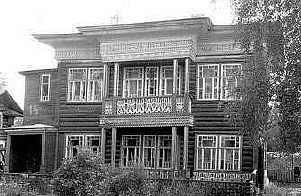
provincial cities such as Kaluga. The real distinction of Vologda is its wooden houses,
many of which still survive, albeit under most interesting examples - in terms of
decoration, if not structure - is the Vorobev house (1910), whose carved ornament reflects
the influence of style moderne, the Russian equivalent of art nouveau (Photo
16, 17, 18, 19, 20, 21, 22, 23, 24, 25, 26, 27, 28, 29, 30, 31, 32, 33, 34). Many other
examples still remain, with distinctive features such as protected entrances and
second-story loggias. Unfortunately, the advances of decay and neglect are often evident,
and there are few resources for renovation. The dilapidated appearance of these solidly
built and Grafted structures supports the arguments of those for whom such buildings are a
useless encumbrance. Under these circumstances, photography is essential to record what
remains of this architectural legacy in the Russian north.
As for the more traditional northern vernacular
architecture, an attempt has been made to establish an open-air museum near the village of
Molochnoe, a few kilometers to the northeast of Vologda. There are numerous such parks
devoted to the preservation and display of wooden architecture throughout European Russia.
The design of the one near Vologda is unusual in its apparent fidelity to the plan of a
typical northern village, rather than an artificially close arrangement of interesting
buildings.
However, this project is close to a standstill for lack of
funding. The reassembled houses stand with temporary roofs, and work proceeds
sporadically. In the meantime, at least one church intended for the park has collapsed
before its transportation to the site could take place. Ironically, in its present state
this project resembles some of the actual abandoned villages of the economically-depressed
Russian north, even as the concept of wooden architecture parks is being questioned by
some museum specialists for their artificiality. Despite its problems the Vologda site has
gathered some remarkable examples of northern log dwellings, such as the late
nineteenth-century Bolotova house from the village of Korolevskaya. In harmony with climatic conditions that required
the bringing together of the farmstead into one protected unit during the long winter,
this complex structure includes not only the main living space and a smaller dwelling
attached to the side for a new branch of the family, but also a barn, attached to the
back, for storage and livestock. Such houses need their own specialized study, but the
immediate priority is their preservation.
During the nineteenth century Vologda attained notoriety as
a place of exile for political prisoners, but it also gained the attention of
ethnographers and artists such as Vasily Kandinsky (13). With
the coming of railroads to the north during the last three decades of the nineteenth
century, Vologda became an important regional transportation center. With the concomitant
growth of commerce, the city and its landmarks drew the attention of photographers and art
critics such as Georgii Lukomskii, one of the leading proponents of the neoclassical
revival in Russian archite ture at the beginning of the twentieth century. For aesthetes
such as Lukomskii/ who in 1914 published a book on Vologda, such towns of the Russian
provinces represented an ideal of architectural harmony (14).
Whatever the validity of that ideal, it has been severely threatened in this century.
Although Vologda escaped war damage, it has witnessed other forms of destruction.
Increasing pressures on behalf of redevelopment, with a concomitant demand to demolish
wood dwellings, are changing the face of the city. Although the protection of
architectural monuments during the Soviet period was largely honored in the breach, with
the present economic conditions there appears to be even less effective protection for
historic districts, as old buildings are leveled or modified beyond recognition. At this
point photographic documentation has never been more necessary for preserving a record of
Vologsa's architectural heritage.
ACKNOWLEDGEMENTS
For assistance in preparing the photographs in this article for
publication, I would like to thank the Samuel H. Kress Foundation. These photographs are a
part of the William Brumfield collection at the Photographic Archives of the National
Gallery of Art, Washington.
NOTES
1. An authoritative
survey of the historic architecture of Vologda and other major sites in Vologda Province
is Genrikh Bocharov and Vsevolod Vygolov, Vologda. Kirillov. Therapontovo. Belozersk
(Moscow, 1979). Back
2. For excellent reproductions of some of
the most significant examples of Vologda's religious art (including examples held by
museums in Moscow and St. Petersburg), see Gerold Vzdornov, Vologda (Leningrad, 1979). Back
3. For a discussion of late
seventeenth-century ornamentalism in Russian monastic architecture, and examples such as
the Refectory Church of St. Sergius at the Trinity-St. Sergius Monastery, see William
Craft Brumfield, A History of Russian Architecture (New York, 1993), pp. 170-183. Back
4. The mixture of western and Russian
medieval revival styles is discussed in William Craft Brumfield, "The French
Connection : Victor Hugo, Nikolai Benois, and the Medieval Revival in Russian
Architecture," The Ham-man Review 8 (December 1995) 4:1-13. Back
5. A listing of Vologda's churches at the
beginning of this century and the dates of their construction is contained in the
encyclopedic volume by Fedor Konovalov, Leonid Panov, and Nikolai Uvarov, Vologda.
XII-nachalo XX veka (Arkhangelsk, 1993), pp. 121-24. Back
6. An informative selection of photographs
of pre-revolutionary Vologda is contained in Georgii Lukomskii, Vologda v ee starine (St.
Petersburg, 1914). Back
10. For examples of ceramic decoration on
the facades of Yaroslavl churches, see Brumfield, "Photographic Documentation of
Seventeenth-Century Architectural Monuments in Yaroslavl," Visual Resources, 11
(1995) 2:135-65. Back
12. A comprehensive and well-illustrated survey of
Vologda's wooden houses is: Aleksandr Sazonov, Takoi gorod v Rossii odin (Vologda, 1993).
13. On the importance of Kandinsky's
journey through Vologda to the Russian north in 1889, see Peg Weiss, Kandinsky and Old
Russia (New Haven, 1995), pp. 1-32. Back
14. Lukomskii's book is cited in note 6.
For reference to his views on the harmony of early nineteenth-century Russian provincial
architecture, see William Craft Brumfield, The Origins of Modernism in Russian
Architecture (Berkeley, 1991), chapter 6, with particular reference to pages 292-94. Back
 Built in
1568-70, it is an excellent example of mid-sixteenth-century church architecture based on
Aristotle Fioravanti's Dormition Cathedral (1475-79) in the Moscow Kremlin. After the
Vologda eparchy expanded its territory in 1571, the Sophia Cathedral was intended to serve
as the seat of this bishopric. However, for various political reasons the cathedral was
not consecrated until 1588, after the death of Ivan the Terrible.
Built in
1568-70, it is an excellent example of mid-sixteenth-century church architecture based on
Aristotle Fioravanti's Dormition Cathedral (1475-79) in the Moscow Kremlin. After the
Vologda eparchy expanded its territory in 1571, the Sophia Cathedral was intended to serve
as the seat of this bishopric. However, for various political reasons the cathedral was
not consecrated until 1588, after the death of Ivan the Terrible.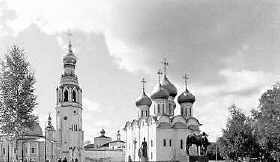
 The interior of the Sophia Cathedral contains some of the
best surviving examples of late seventeenth-century Russian frescoes. In 1686 the
archbishop of Vologda, Gavriil, hired a group of approximately thirty artists from
Yaroslavl that included the most renowned fresco painters of the period, such as Dmitrii
Grigorev Plekhanov who had supervised the painting of the Dormition Cathedral at the
Trinity-Sergius Monastery near Moscow in 1684. In an era when western views of art as a
secular occupation were beginning to penetrate Russia, the artists painted on the walls a
list of their names and a large, elaborate description proclaiming the beginning and end
of their work, from July 1686 to the summer of 1688. (Such proclamations would rarely have
appeared in church art before the seventeenth century.)
The interior of the Sophia Cathedral contains some of the
best surviving examples of late seventeenth-century Russian frescoes. In 1686 the
archbishop of Vologda, Gavriil, hired a group of approximately thirty artists from
Yaroslavl that included the most renowned fresco painters of the period, such as Dmitrii
Grigorev Plekhanov who had supervised the painting of the Dormition Cathedral at the
Trinity-Sergius Monastery near Moscow in 1684. In an era when western views of art as a
secular occupation were beginning to penetrate Russia, the artists painted on the walls a
list of their names and a large, elaborate description proclaiming the beginning and end
of their work, from July 1686 to the summer of 1688. (Such proclamations would rarely have
appeared in church art before the seventeenth century.) 
 The next major project within the eparchal compound was a new building for the
Archbishop's Chambers, named after the archbishop that commissioned them: Joseph Zolotoi.
This new residence, built in 1764-69, demonstrates the incursion of secular palace design
into religious institutions during the eighteenth century - a development represented most
notably in St. Petersburg's Smolny Convent and Alexander Nevskii Monastery. Furthermore,
the decorative program of the residence - its exuberant use of painted trompe-l'oeil
rustication and other elements on the main brick facade (itself painted red) - represents
a provincial adaptation of an ornamental approach to architectural design prevalent in
Muscovy at the end of the seventeenth century
The next major project within the eparchal compound was a new building for the
Archbishop's Chambers, named after the archbishop that commissioned them: Joseph Zolotoi.
This new residence, built in 1764-69, demonstrates the incursion of secular palace design
into religious institutions during the eighteenth century - a development represented most
notably in St. Petersburg's Smolny Convent and Alexander Nevskii Monastery. Furthermore,
the decorative program of the residence - its exuberant use of painted trompe-l'oeil
rustication and other elements on the main brick facade (itself painted red) - represents
a provincial adaptation of an ornamental approach to architectural design prevalent in
Muscovy at the end of the seventeenth century  A
survey of Vologda's church architecture reveals a considerable variety of forms, but it
has been noted that unlike other major centers to the north and east of Moscow, such as
Yaroslavl and Kostroma, Vologda produced no distinctive local style
A
survey of Vologda's church architecture reveals a considerable variety of forms, but it
has been noted that unlike other major centers to the north and east of Moscow, such as
Yaroslavl and Kostroma, Vologda produced no distinctive local style The
area to the north of the archbishop's court, the so-called Upper Settlement/ once
contained a rich concentration of historic monuments; but its current state shows the
alterations of unregulated post-war construction. The oldest surviving monument is the
Church of Saints Constantine and Helen, built in 1690. As is typically the case in
Vologda, the church was founded much earlier - perhaps at the beginning of the sixteenth
century - and existed as a log structure until its reconstruction in brick. On the
exterior, it is one of the best surviving examples of late seventeenth-century
architecture in the Vologda region, with two rows of decorative gables leading upward to
an array of five cupolas. But during the Soviet period the interior of the church was
defaced and gutted, and it now houses the lathes and other industrial machinery of a
woodworking shop. The graceful bell tower, attached to the northwest corner, has long
stood without bells.
The
area to the north of the archbishop's court, the so-called Upper Settlement/ once
contained a rich concentration of historic monuments; but its current state shows the
alterations of unregulated post-war construction. The oldest surviving monument is the
Church of Saints Constantine and Helen, built in 1690. As is typically the case in
Vologda, the church was founded much earlier - perhaps at the beginning of the sixteenth
century - and existed as a log structure until its reconstruction in brick. On the
exterior, it is one of the best surviving examples of late seventeenth-century
architecture in the Vologda region, with two rows of decorative gables leading upward to
an array of five cupolas. But during the Soviet period the interior of the church was
defaced and gutted, and it now houses the lathes and other industrial machinery of a
woodworking shop. The graceful bell tower, attached to the northwest corner, has long
stood without bells. 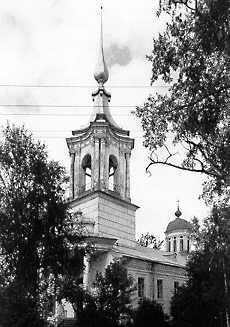 Among the few other churches still preserved in this district, the most elegant is Saint
Varlaam Khutinskii (1780), built in a neoclassical style whose detailing and proportions
are distinctly unprovincial (
Among the few other churches still preserved in this district, the most elegant is Saint
Varlaam Khutinskii (1780), built in a neoclassical style whose detailing and proportions
are distinctly unprovincial (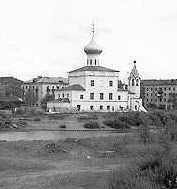 is named
after its location in a district settled by foreign merchants, who in medieval Russia were
often given the generic designation of friaziny, or "Franks." This church (also
known as the Church of the Apostle Andrew) has been much altered by the replacement,
perhaps in the early nineteenth century, of its original five cupolas with one. No
photographic documentation exists of the earlier form, but traces of arches that supported
the four subsidiary drums and cupolas can still be seen on the interior. The structure is
unusual in having only two large interior piers, rather than four.
is named
after its location in a district settled by foreign merchants, who in medieval Russia were
often given the generic designation of friaziny, or "Franks." This church (also
known as the Church of the Apostle Andrew) has been much altered by the replacement,
perhaps in the early nineteenth century, of its original five cupolas with one. No
photographic documentation exists of the earlier form, but traces of arches that supported
the four subsidiary drums and cupolas can still be seen on the interior. The structure is
unusual in having only two large interior piers, rather than four.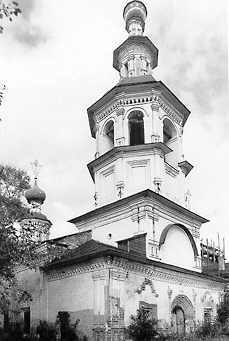 Farther to the north along the embankment stands the Church of Saint Dmitrii Prilutskii, a
revered local cleric who in 1371 founded a monastery to the north of the city. In fact
this is a compound of two churches, one could be heated for winter use (the
"warm" church) while the other - a larger, unheated building (the
"cold" church) - was used in the summer. The pairing of churches, whether of
logs or masonry, for seasonal use was a common practice in many parts of Russia/ with each
church in the pair having its own dedication. In this case the larger of the two is the
older, built around 1650 by two architects from Yaroslavl
Farther to the north along the embankment stands the Church of Saint Dmitrii Prilutskii, a
revered local cleric who in 1371 founded a monastery to the north of the city. In fact
this is a compound of two churches, one could be heated for winter use (the
"warm" church) while the other - a larger, unheated building (the
"cold" church) - was used in the summer. The pairing of churches, whether of
logs or masonry, for seasonal use was a common practice in many parts of Russia/ with each
church in the pair having its own dedication. In this case the larger of the two is the
older, built around 1650 by two architects from Yaroslavl  A
similar situation confronts the Church of the Purification, the northernmost religious
monument on this section of the embankment. Built in 1731-35, the church combines elements
of traditional seventeenth-century design, but in a refined treatment that reflects the
early baroque aesthetic in Russia. In particular the proportions of the elevated main
structure are unusually slender, although the weighty, ornamented cornice, with double
dentilation, provides an emphatic stop to the vertical ascent. Above the cornice the
vertical emphasis continues with narrow drums and five cupolas, which culminate in the
elaborate ironwork of the crosses. The white-washed brick walls contain decorative window
surrounds that combine the seventeenth-century style with traces of the Petersburg
baroque; but the most remarkable ornamental effect is the use of strips of polychrome
ceramic tiles to outline the structure (including the cornice) and the window surrounds.
Although this device was frequently applied in Yaroslavl churches of the late seventeenth
century, its use here is unique among the monuments of Vologda.10 The bell tower,
connected to the main sanctuary by a lower refectory, was rebuilt in the mid-1830s, when
it gained its lancet arches in the upper tier
A
similar situation confronts the Church of the Purification, the northernmost religious
monument on this section of the embankment. Built in 1731-35, the church combines elements
of traditional seventeenth-century design, but in a refined treatment that reflects the
early baroque aesthetic in Russia. In particular the proportions of the elevated main
structure are unusually slender, although the weighty, ornamented cornice, with double
dentilation, provides an emphatic stop to the vertical ascent. Above the cornice the
vertical emphasis continues with narrow drums and five cupolas, which culminate in the
elaborate ironwork of the crosses. The white-washed brick walls contain decorative window
surrounds that combine the seventeenth-century style with traces of the Petersburg
baroque; but the most remarkable ornamental effect is the use of strips of polychrome
ceramic tiles to outline the structure (including the cornice) and the window surrounds.
Although this device was frequently applied in Yaroslavl churches of the late seventeenth
century, its use here is unique among the monuments of Vologda.10 The bell tower,
connected to the main sanctuary by a lower refectory, was rebuilt in the mid-1830s, when
it gained its lancet arches in the upper tier 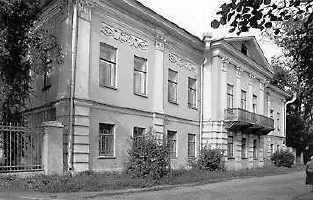
 For this type of domestic architecture, however, one can find better examples in other
provincial cities such as Kaluga. The real distinction of Vologda is its wooden houses,
many of which still survive, albeit under most interesting examples - in terms of
decoration, if not structure - is the Vorobev house (1910), whose carved ornament reflects
the influence of style moderne, the Russian equivalent of art nouveau (
For this type of domestic architecture, however, one can find better examples in other
provincial cities such as Kaluga. The real distinction of Vologda is its wooden houses,
many of which still survive, albeit under most interesting examples - in terms of
decoration, if not structure - is the Vorobev house (1910), whose carved ornament reflects
the influence of style moderne, the Russian equivalent of art nouveau (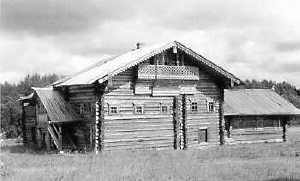 In harmony with climatic conditions that required
the bringing together of the farmstead into one protected unit during the long winter,
this complex structure includes not only the main living space and a smaller dwelling
attached to the side for a new branch of the family, but also a barn, attached to the
back, for storage and livestock. Such houses need their own specialized study, but the
immediate priority is their preservation.
In harmony with climatic conditions that required
the bringing together of the farmstead into one protected unit during the long winter,
this complex structure includes not only the main living space and a smaller dwelling
attached to the side for a new branch of the family, but also a barn, attached to the
back, for storage and livestock. Such houses need their own specialized study, but the
immediate priority is their preservation.